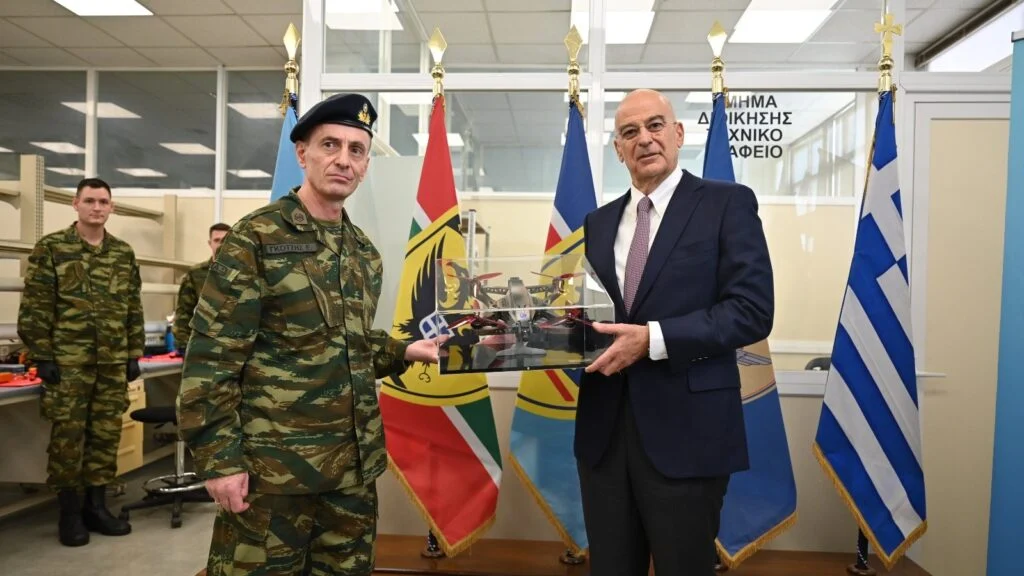
Greek Defence Minister Nikos Dendias has unveiled one of the most ambitious military transformation programmes in modern Greek history, declaring that Athens intends to develop the capacity to produce more than one million drones annually by the end of the decade.
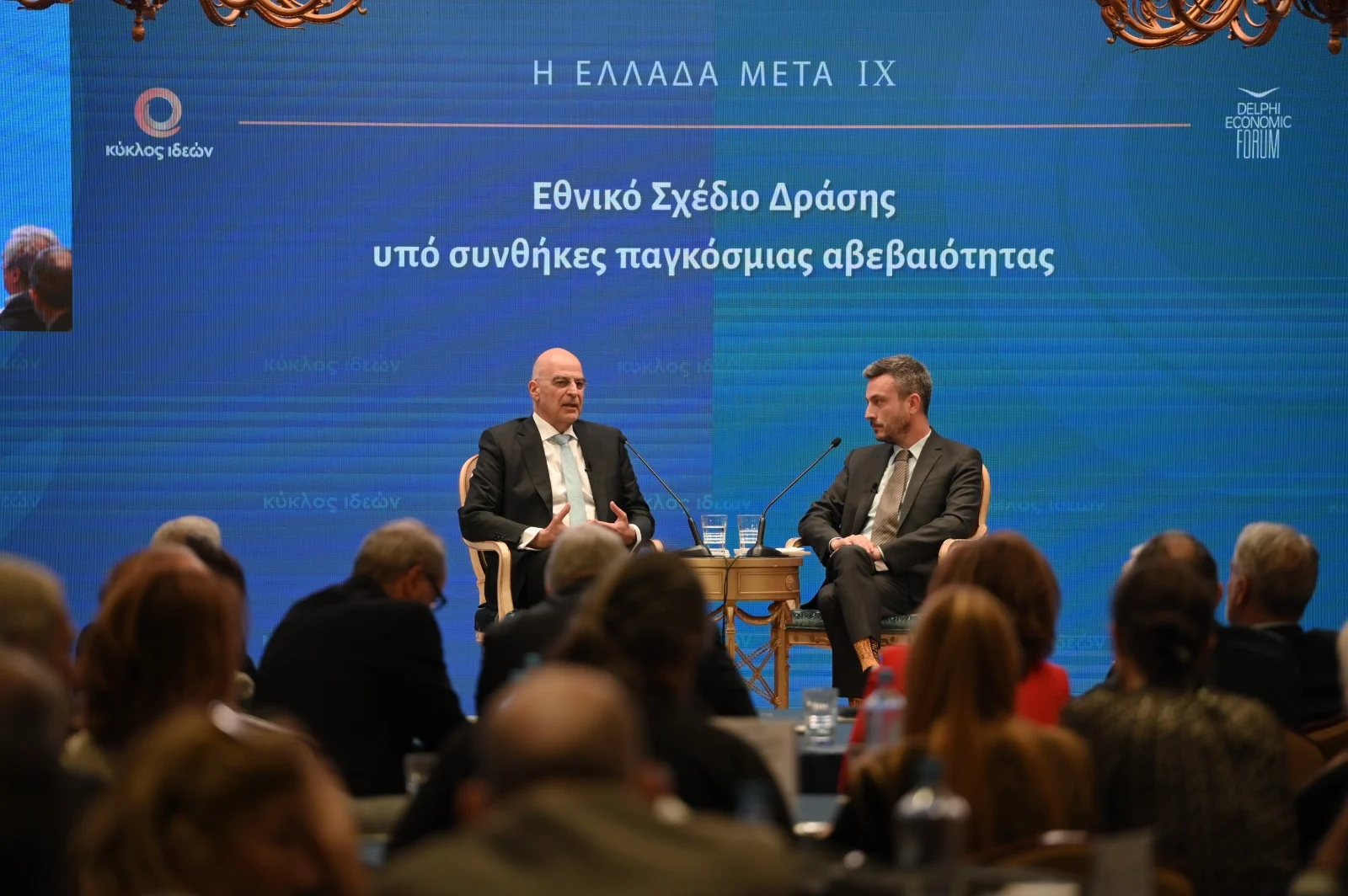
Speaking during the “National Action Plan Under Conditions of Global Uncertainty” conference on Wednesday, 20 May, Dendias outlined the core pillars of the country’s sweeping “Agenda 2030” defence reform initiative while responding to questions from journalist Vasilis Nedos. His remarks ranged from Greece’s future unmanned systems strategy to the broader security outlook in the Aegean and relations with Türkiye.
According to reporting by Defence Review GR, Dendias characterised “Agenda 2030” as a complete doctrinal shift for the Hellenic Armed Forces rather than a conventional modernisation programme.
“This project represents a full paradigm change,” the minister said. “It is no longer enough to simply procure expensive systems and maintain highly capable personnel. We are building an entirely new architecture for information processing and operational management. We have entered a different era.”
He argued that the age of relying exclusively on massive, high-cost military platforms is gradually giving way to smarter and more affordable systems capable of delivering asymmetric battlefield advantages.
A major component of the initiative is the rapid expansion of Greece’s domestic drone production infrastructure. Dendias revealed that two primary drone manufacturing facilities have already been established within the Greek military structure. In parallel, the armed forces are developing deployable drone-production capabilities using mobile units equipped with 3D printers.
Under the plan, those mobile facilities will accompany major brigade formations, enabling frontline units to manufacture unmanned aerial systems directly in the field. Within two years, every brigade in the Greek Army is expected to possess the ability to produce its own operational drones internally, with commanders able to programme and reconfigure mission parameters in real time according to tactical requirements.
The production targets outlined by Athens are particularly striking. Greece currently possesses the capacity to manufacture approximately 5,000 drones per year, according to Dendias. He stated that this figure is expected to exceed 100,000 annually within the next 18 to 24 months. By the end of 2030, Greece aims to achieve a theoretical production capability surpassing one million drones per year.
The minister nevertheless stressed that such industrial capacity should not be interpreted as an intention to indiscriminately stockpile unmanned systems.
“We will possess this capability,” he noted, “but that does not mean we intend to spend the entire defence budget accumulating drones in warehouses.”
Dendias also addressed recent controversy surrounding the withdrawal of Patriot air defence missile system batteries from the island of Karpathos. Responding to speculation that the deployment had been linked to Türkiye, he firmly rejected that interpretation.
“The Patriot systems stationed on Karpathos were not deployed there because of a Turkish threat,” he said. “Their deployment was entirely connected to the missile threat originating from Iran. As there has been no Iranian missile launch threat during the last six weeks, there is no operational necessity to keep those systems exposed at that location.”
On the subject of relations with Türkiye, Dendias adopted a markedly cautious tone despite ongoing diplomatic engagement between Athens and Ankara. Referring to reports concerning new Turkish legislative drafts, he warned against complacency in interpreting the current atmosphere in the Aegean.
“I am not among those who believe in the narrative of ‘calm waters’ in relations with Türkiye and become carried away by it,” the Greek minister stated. “I do not wish to construct a dialogue in advance based on media leaks. However, if those leaks prove accurate, the situation would be deeply troubling — in fact, ‘troubling’ may be too mild a word.”
He added that if Türkiye were to pursue escalation or provoke a crisis, Greece would remain constitutionally obligated to defend both its borders and sovereign rights “to the fullest extent.”
The remarks underline how rapidly unmanned warfare and distributed manufacturing concepts are moving to the centre of Greek defence planning. At the same time, they also reflect the enduring strategic mistrust that continues to shape the security balance between Athens and Ankara, despite periods of diplomatic rapprochement.